
The Big News Breakdown. Unpacking this week’s most important news.
“Something’s got to be done about Mexico.” Those were the US president’s words on Fox News hours after his government’s strike and abduction of Venezuela’s Nicolás Maduro.
Fears that the US will attack Mexico militarily are not new. They date from before Donald Trump was re-elected. But the shocking operational success of the Venezuelan strikes have made observers all the more concerned that this has become a real possibility.
The thing is: Mexico is not Venezuela. That is not only a statement of the obvious but also an invitation to truly understand where Mexico lies in the midst of this massive geo-political reconfiguration.
It’s time to look at the political economy of Mexico in this new age of Great Power spheres of influence.
Great Power geo-politics
The attacks on Venezuela were geopolitical and not about democracy. To the extent that Trump was perfectly happy to throw María Corona Machado—the leader of the Venezuelan opposition—under the bus on day one to, instead, have pragmatic discussions with the remaining Chavista regime in Caracas.
Whereas previous international forays by the US were couched in the language of democracy and freedom, only cursory mentions of these have crossed Trump’s lips. Economic considerations (starting with oil) and the strategic consolidation of the US in the Western Hemisphere are his main concerns.
This nationalist approach and the success of the mission has fueled bravado and jingoistic sentiment across the US. So, while Mexicans fixated on Trump’s flippant comment that the attack on Venezuela “wasn’t meant to be” a warning to Mexico but “it could be,” other countries have focused on the far more explicit threats made against them:
The annexation of Greenland has been re-opened by Trump and his supporters. Cuba and Colombia were told in no uncertain terms to “watch their ass.” Yet, the more Trump talks about Mexico the clearer it becomes that his government’s approach would be totally different. When the military is mentioned, it is done so through the insistence of aid and cooperation in the fight against cartels alongside the Mexican government.
The US government has a good working relationship with president Claudia Sheinbaum, though Trump officials worry that she is surrounded by bad actors. If military strikes were put on the table, they would be almost the opposite of what we saw in Venezuela—a hit on anyone except for Sheinbaum and her inner circle.
Such action would undoubtedly destroy cooperation with the US from Mexico, so Trump is likely to try different forms of pressure.
It is already being applied, starting with the US Department of Justice’s indictment of Maduro where corrupt Mexican officials were accused of helping Venezuelan cartels move drugs and money under diplomatic immunity. This is where the biggest demands on Sheinbaum lie and there could be increasing issues if she continues to resist the calls from the US (and within her own country) to cleanse her government of such high-level corruption.
Will this translate into the bombing of Mexico City? Unlikely. Trump’s penchant for bravado is taken to be his main characteristic, yet while many are emphasising the “military” aspect of the “surgical military strikes” in Venezuela, it is worth considering the “surgical” part too. The US has other ways of pressing its case in Mexico.
It’s not the same economy, stupid
Venezuela was invadable because it was no longer working in the way the US wanted it to work. A principal reason for the strike was to secure the Western Hemisphere’s largest oil reserves for a potential conflict and supply chain disruption in other hemispheres.
Mexico’s supply chain integration with the US works. It works so well that Trump has already previously been moved to reconsider his guns-a-blazing approach on tariffs when it came to his southern neighbour.
Mexico is the US’s main trading partner. Venezuela barely features:
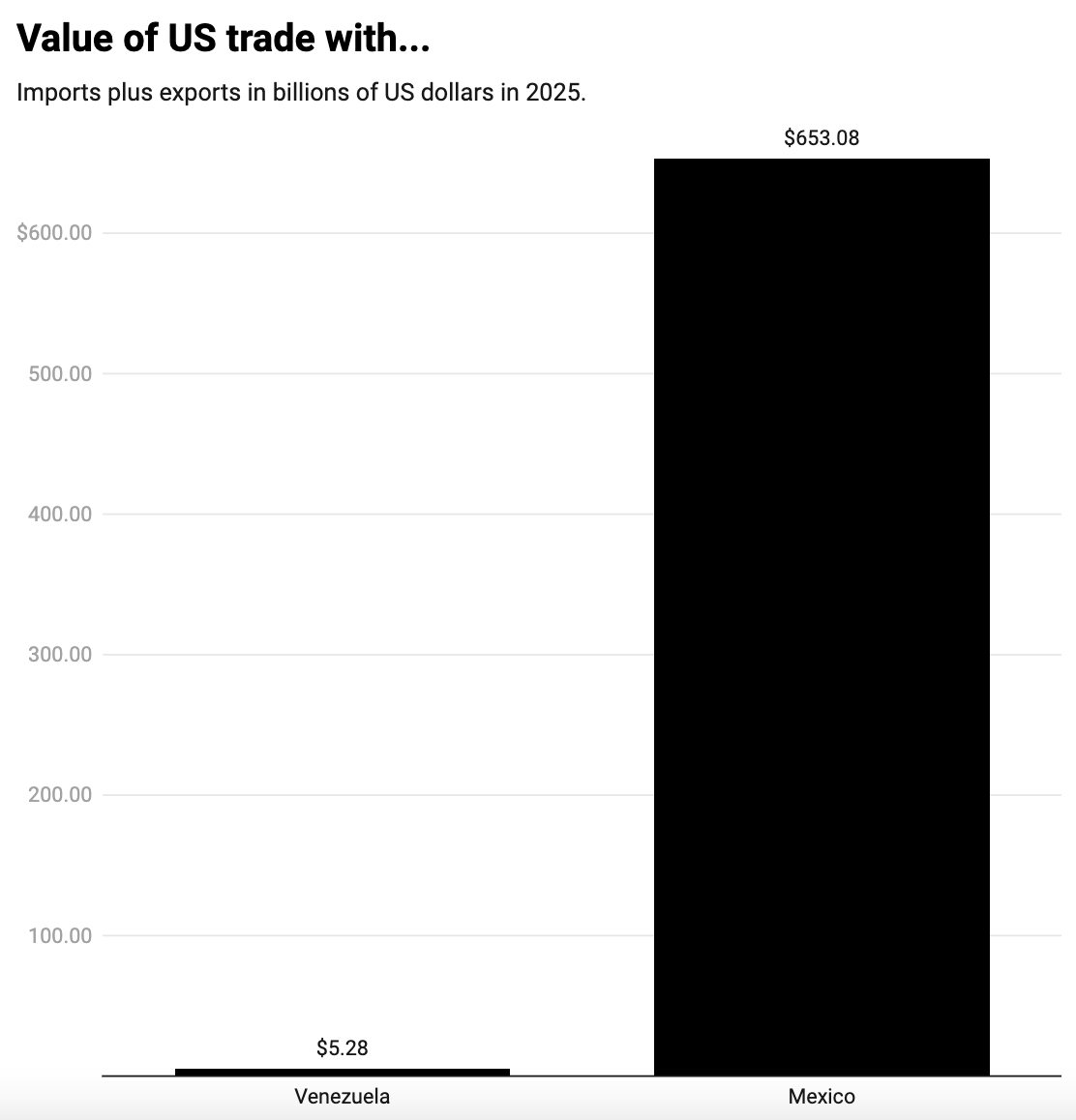
Yet, for this reason too the US holds much leverage over Mexico in economic terms. The “strike” will more likely come via the upcoming US-Mexico-Canada Trade Agreement (USMCA) negotiations. However, the US will have to be even more surgical than with Maduro here, because any adverse effect on the US-Mexico supply chain would spell disaster for the US economy.
The battle for public opinion
The bombs in Caracas have damaged the US-Mexico relationship in other ways. While at a high-level there seems to be a degree of trust between the Mexican and US governments, the way both societies see each other is crumbling.
The strikes in Venezuela threaten to poison the well of public opinion in Mexico. “Every time I talk to [Sheinbaum] I offer to send her troops,” said Trump in an interview last night. He seemed bewildered as to why she’d reject the sincere offer of help, concluding that the cartels must be threatening her.
Usually, to explain the real reason why Mexican governments are so obsessed with sovereignty, one must recount the country’s and the region’s checkered history with US military incursions. As of now, one need only look to the weekend to see how little the US cares about other nations’ sovereignty.
At the time of writing, the Mexican Congress had cancelled a session in which it was to rubber-stamp the entry of US troops for a recurrent training of Mexican soldiers. If this previously routine step in the bilateral cooperation agenda has stalled, imagine the rest.
While Mexicans say they dislike the US under Trump more than ever, the turn of the US media against Mexico—and specifically its government—has ramped up significantly too. Republican congresspeople openly attacked Sheinbaum after her mild response condemning the attack on Venezuela on the basis of the UN Charter.
And yet, the Mexican government has been unwilling or unable to address the broader US public effectively. Public opinion is a flank no government should leave unattended during the administration of the US’s first reality TV president.
The foreign leaders with the most influence on the US are often those who play the media game savvily. Think Bukele’s English-subtitled and high production value viral videos. Or Netanyahu’s constant forays onto Fox News. Even the Mexican right—so deflated at home—is far better than Sheinbaum’s surrogates at going on the news and influencing public opinion.
That should worry Mexico’s president, whose government was so easily brought into the cross-hairs of Donald Trump after being mentioned by a TV host in the same breath as the military attack on Venezuela.