
Mexico and Canada take opposing paths to Chinese and US trade
These two USMCA partners have yet to turn to a new potent economic ally: each other.
On paper, there is an easy answer as to why Canada is opting to free up trade with China while Mexico is putting up barriers.
It is that the people in power in each country are ideological opposites:
Canadian prime minister Mark Carney is a traditional technocrat moulded within the global free trade consensus of the late 20th Century. Mexican president Claudia Sheinbaum is also a technocrat, but one forged in the nationalist anti-neoliberal movements of the left.
But this analysis does not hold up to scrutiny. When it comes to the North American free trade project, it often feels like Sheinbaum’s Morena party government is the region’s biggest defender.
Today, the Canada-US-Mexico Agreement (CUSMA as Canadians refer to the USMCA) is under threat. It is up for review in the middle of 2026 and Donald Trump has publicly stated his disdain for the project.
The US president’s position has moved his CUSMA partners in opposite directions. There are many cultural and political reasons for Mexico and Canada to react differently, but central to these has been the complementarity of their economies in relation to the US.
The US and Mexican economies are highly complimentary. The US sends aluminium and barley; Mexico returns beer made from those inputs. This means that, despite the Trump administration’s economic nationalism, bilateral trade has only increased since the trade wars began.
Canada’s case is the opposite. Its economy and that of its southern neighbour’s have converged, turning them into competitors. For instance, Canada’s shale sands now compete directly with Texas’ Permian Basin deposits and, perhaps eventually, with US controlled Venezuelan heavy crude.
Trump’s industrial priorities also put the US economy at odds with Canada’s, as vehicles, steel, and aluminium have been targeted for tariffs. Mexico doesn’t produce aluminium, while Canada is a major global producer. Mexican automakers continue to compete on price despite tariffs; Canadians not so much.

Leave the gun, take the canola
This dynamic has naturally affected how Mexico and Canada triangulate in relation to China, the other big economic player on the block. Carney recently headed to Beijing, opening Canada’s auto market to cheap Chinese imports in exchange for lower tariffs on agricultural exports. Meanwhile, Mexico is increasing tariffs on China to prevent these very sorts of wares from undercutting its industry.
What has gone unnoticed by Mexican and Canadian business and policymakers is that instead of alienating China or exposing themselves to its subsidised goods, both countries would be better served by increasing trade with each other’s largely complimentary economies.
Unfortunately, the urgency of ongoing geopolitical shifts has distracted these two CUSMA partners from the potential of integrating more closely with each other.
The Mexico Political Economist has argued for further economic integration and so has Export Development Canada—Canada’s export credit agency—which earlier this year said:
“There are many products, for example, that Mexico imports through China, which can easily be sourced from Canada, and vice versa. Of the US$114 billion worth of products that Mexico imports from China, Canada exports about US$4.8 billion worth of comparable products to China, including autos and parts.”
This is also true of the agricultural sector. Mexico is almost entirely dependent on canola seed imports while Canada is one of the world’s greatest producers. And yet, in recent years, Canadian canola imports to Mexico have fallen, giving way to further dependency on both sides—with Mexico depending more on the US for imports and Canada depending more on China’s market for its exports.
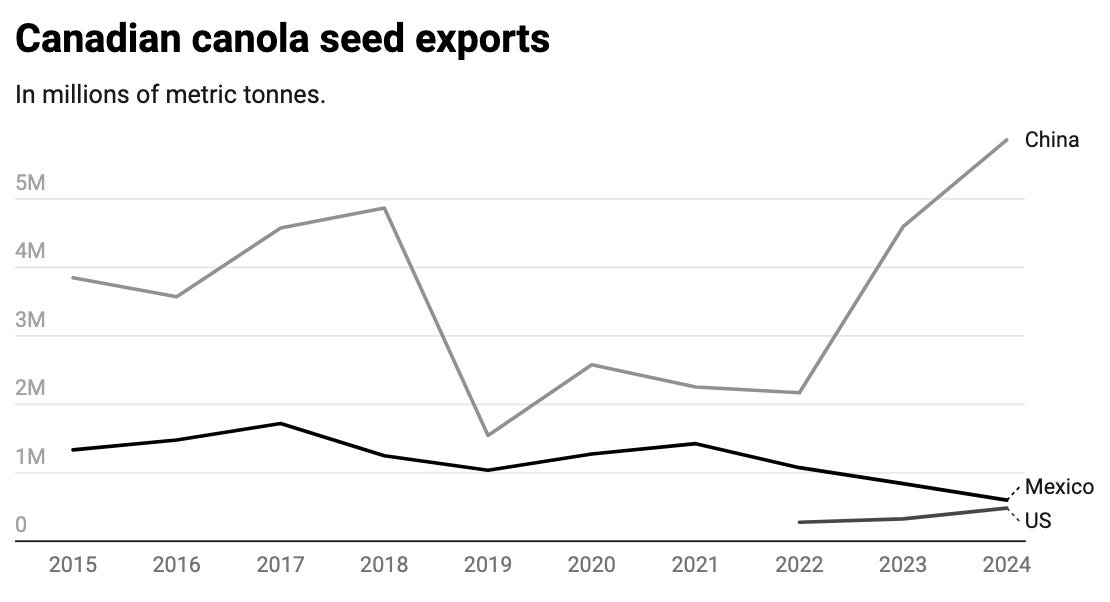
Source: Statistics Canada, Canadian International Merchandise Trade Database
Beyond canola, the story isn’t any more encouraging. Despite positive sounds made emerging from bilateral meetings in the wake of US economic nationalism—including an Action Plan signed by Carney and Sheinbaum last year—the Mexico-Canada trade relationship has only slowed.
One reason, according to Shauna Hemingway—senior special advisor for Mexico and the Americas at the Business Council of Canada—is “uncertainty around trade policy, particularly with regard to tariffs, [which] has had a noticeable impact on the deployment of capital, investment decisions, and business confidence across North America.”
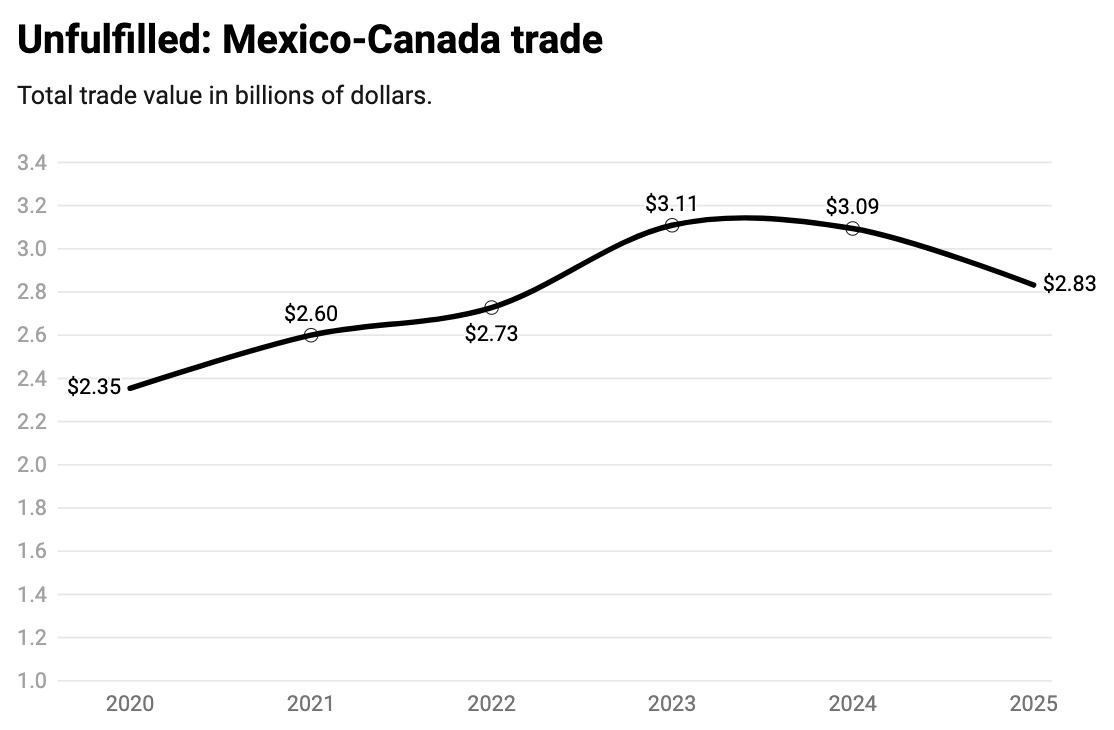
Source: Radiografía del T-MEC, Mexican Chamber of Deputies.
Slowly but surely, however, there have been movements to mitigate the decline. Hemingway told The Mexico Political Economist that in a month’s time a high-level delegation of up to 300 Canadian companies and top governmental ministers will be heading to Mexico to deepen business-to-business ties.
Whether this will make a dent in the encroachment from Chinese and US trade in both countries remains to be seen.