
Mexico is the source of US economic growth
Mexican labour can be found in everything keeping the US economy afloat.
As the US and Mexico announced that they’d be beginning official talks for the Joint Review of the US-Mexico-Canada Agreement (USMCA), the Mexican Embassy in Washington published a series of stats set to entice Mexico-skeptics with hard stats.
The numbers are meant to show how interlinked and mutually beneficial the bilateral economic relation is. It remarks on how much Mexican companies invested in the US in 2025—$61.7 billion dollars. It also highlighted how Mexico buys more from the US than China, Japan, and South Korea put together.
The headline figure was the big number at the top—total bilateral trade, amounting to $873 billion dollars or $1.7 million a minute.
It’s all very impressive but also meaningless to the uber-skeptics in the Trump administration.
Donald Trump, as an economic nationalist, is particularly keen for countries to buy more from the US and for the US to buy less from them. Mexico’s dependency on selling lots to its northern neighbour puts it in a weak negotiation position. The refrain from the White House over the past year has been: “The United States holds all the cards; it doesn’t need anyone else.” These numbers as presented contribute to this argument.
If Mexico exports $535 billion dollars to the US and imports $338 billion, the Trumpian mind may well be expected to see this:
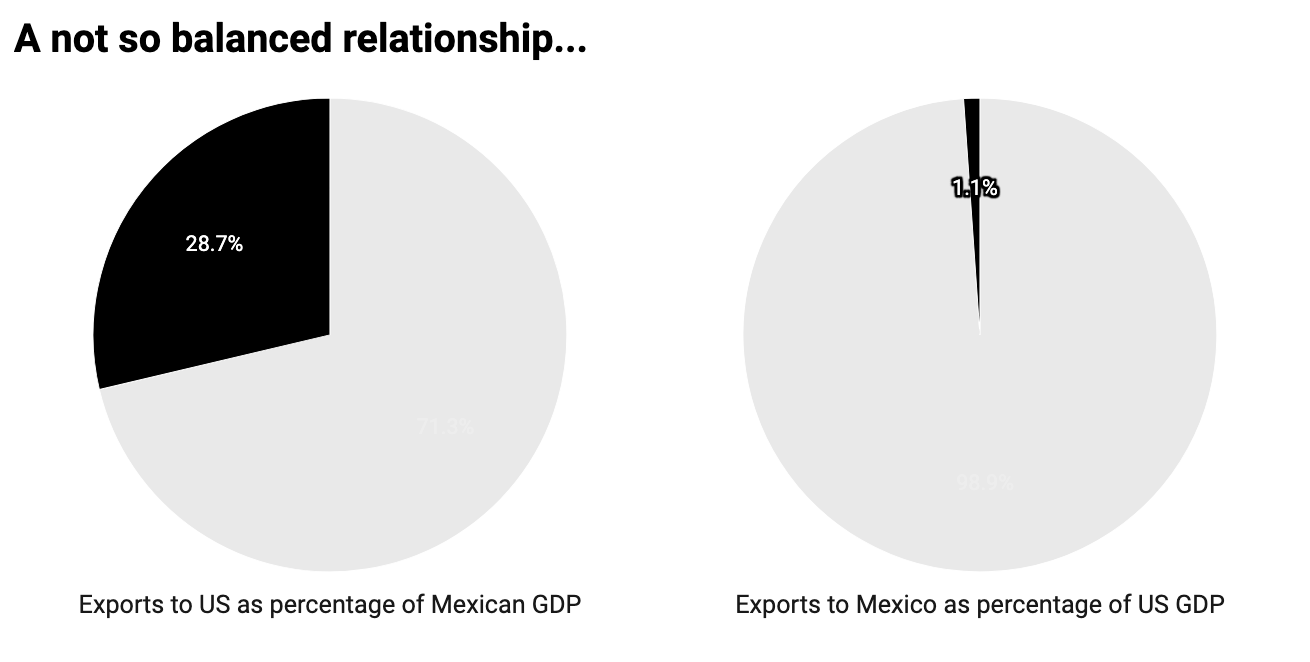
Yikes.
Yet, these stats don’t go far nor deep enough. So, jump down this economic rabbit hole and find out just how far down this relationship really goes.
Mexico as inflation deccelerator
Bilateral trade has second and third order effects that have been well studied but which do not often get put into the media’s thirty second clips about US-Mexico relations.
These are the good and services that get exported back and forth across the border, enriching the final product far more than if it has been made in just one country or the other.
Montana might seem a long way away from Mexico, but most of the malt barley grown in the state ends up in Mexican breweries. But the relationship doesn’t stop at the barley farmers’ bottom line. Mexican beer will then reenter the US market consistently beating cheaper beers on quality and more decent tipples on price.
This may seem like a trivial point, but it actually reflects what Mexico does better than almost any other country: It is an economy that produces higher quality outputs at lower prices.
The effect spreads across industries, lowering the prices of inputs without which the final product impossibly expensive without compromising on quality. It is why the North American auto industry is so deeply integrated—any car made in the US needs Mexican-made components to keep it from becoming either unaffordable or unsafe.
Usually, as if the only audience was business, US-Mexico trade integration is framed in terms of competitiveness—cheap, skilled labour keeps profits up. But the other side of the coin is crucial too: Mexican imports into the US economy keep prices down. It is why Mexican exports to the US are up by 5% a year into Trump’s tariffs.
Skeptics may shake their heads and say that automation will soon replace foreign low-value yet technical labour with AI. Perhaps… But, in the meantime, there is some terrible news for these anti-Mexico holdouts.
Mexico is the soap that keeps air in your AI bubble
Artificial intelligence will no doubt completely change how labour and trade works globally. Increasingly sophisticated tasks will be handed-off to machines. Yet someone has to make these increasingly sophisticated machines first.
Hardware is valued at less than a third of the total value of the AI industry. Those are still enormous costs linked to the physical infrastructure that makes these large language models tick.
Data centres, CPUs, semiconductors… all of this stuff is being made at rates that no single country can keep up at. Worse still, AI dominance is at the heart of global geopolitical tensions, so the race is on with no time nor money to lose.
As with beer and with cars, the United States has once again turned to Mexico to supplement its missing industrial capacity and obtain a lot of the kit needed to drive its AI boom.
In 2025, Mexico made up 36.6% of US computer imports—up 86% from the previous year compared with a 66% fall from China. Every other contender is Asian, with Taiwan in second place—an island ever under the threat of conflict and supply chain disruption.
For AI-adjacent hardware imports into the US, the numbers are even more stark. According to Gilberto García-Vazquez, chief economist at the Net Zero Industrial Policy Lab (NZIPL), 97% of AI‑proximate CPUs come from two places: Taiwan and Mexico. Taiwan is where the advanced fabs are; Mexico’s role is in affordably but skillfully assembling these complex machines.
Despite local concerns that have frozen most other investment in Mexico, computer manufacturers continue to pour money into Mexican operations. Foxconn alone has 14 plants all across the country.
When seen from that angle, the graphs suddenly paint the US’s leverage over Mexico in a far less flattering light:
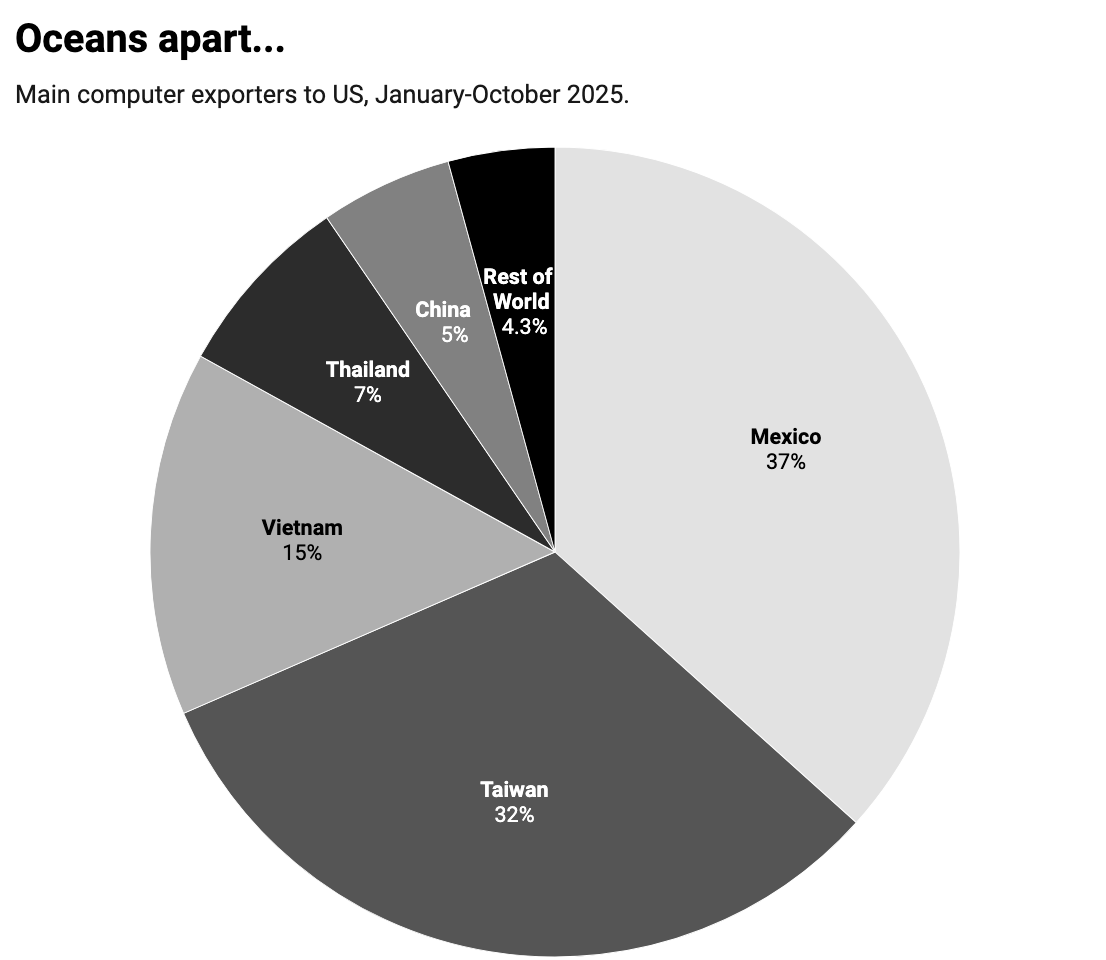
But don’t look as far as conflict with China. Mexico’s importance to the US economy is apparent here and now. Manufacturing and other economic sectors in the US have stalled recently (just look at this month’s falling job numbers). What has kept the economy buoyant has been AI investment—through the third quarter of 2025, AI-related industries made up 39% of total GDP growth.
The simple truth is in the long run but also to this very day, Mexico is the driver of the United States’ continued power and prosperity. It’s a reality even the staunchest economic nationalists stateside would do well to wake up to.