A fiercely nationalistic government seen to be suspicious of the private sector wouldn’t normally consider going down this route. The issue with Mexico’s Morena party government—a left-wing nationalist administration—is that there is little money to spare and president Claudia Sheinbaum, sources near her told The Mexico Political Economist, understands that her agenda will not work if the economy stalls.
The impasse is clear: Mexico needs investment. Its indebted State cannot provide it, so the money must come from the private sector. But the private sector will not budge until a few basic requirements are met—and this administration, say businesses, is finally starting to listen.
Despite much focus being given to ideological differences between the State and business, the roadblocks facing investment in Mexico are actually far more tangible.
Back to building basics
More than cartels, corruption, or policy, the private sector overwhelmingly sees a lack of reliable access to basic public services—namely electricity—as the main impediment to doing business in Mexico. In this regard, the country is a victim of its own success as the world’s seventh most industrialised nation—as measured by industrial output—ahead of Italy, France, and the UK.
There are many regions across Mexico with good access to all essential services; the problem is that they are under enormous demand. In a bad year, industrial real estate across the country is at an occupation rate of over 95%. The saturation is such that many firms looking to expand into Mexico have been forced to do so by straight-up acquiring locally based companies just to gain their plot of industrial land.
Sheinbaum’s government has poured the little public money it has into trying to open up more of Mexico for manufacturing growth. In and around the country’s 26 “development poles”—economic regions with specialised sectorial focuses—public cash has been invested into strengthening the rail network, expanding ports, repaving roads, laying transmission lines…
But this isn’t enough, and the government knows it. So, early in her administration, Sheinbaum sought help from the private sector—specifically the firms that could help her build the foundations for the rest of Mexico’s industrial expansion.
Industrial parks and reactivation
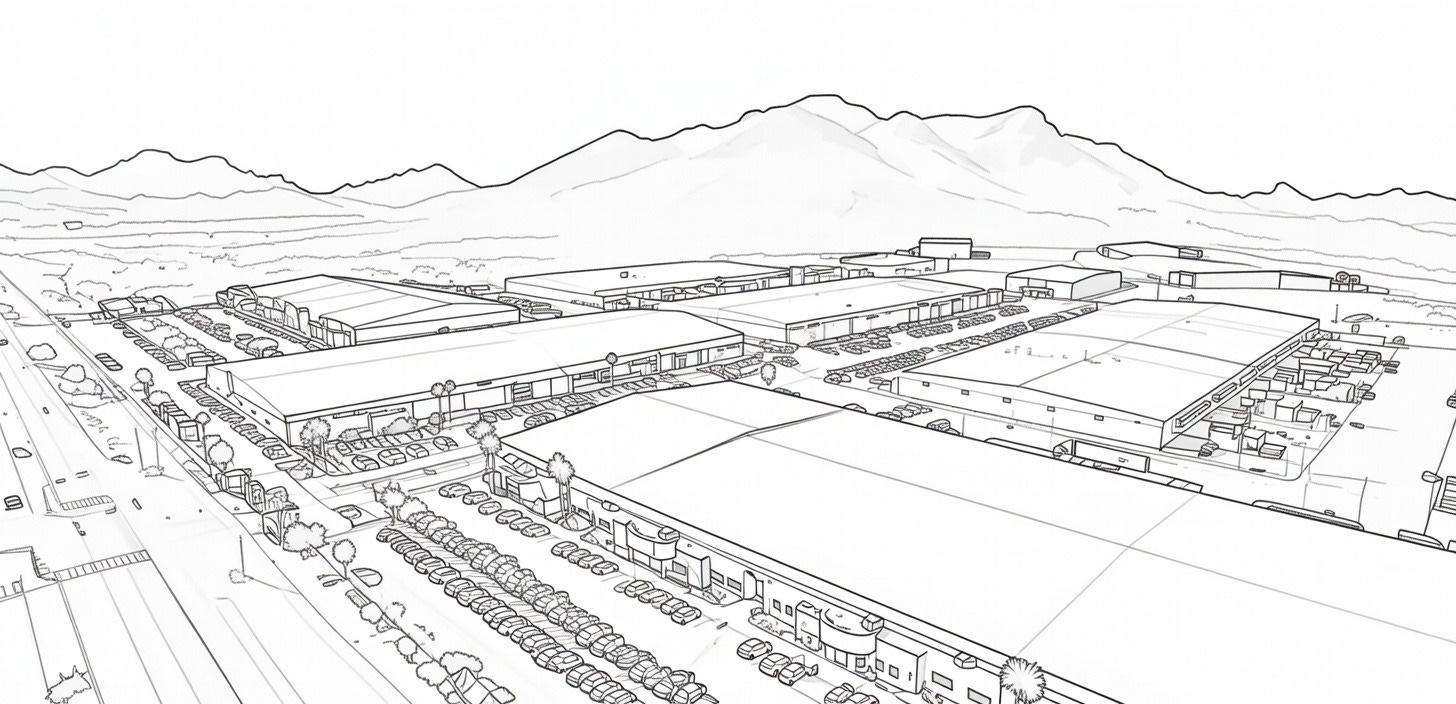
Industrial parks house a significant portion of Mexico’s manufacturing capacity and that amount is only set to grow. The reason is that these privately administered industrial sites make their money by developing land and endowing it with the sorts of strategic services that most individuals are used to receiving from the State.
From its creation, Plan Mexico—Sheinbaum’s flagship industrial policy—endowed industrial parks with access to far more support that they’d had before:
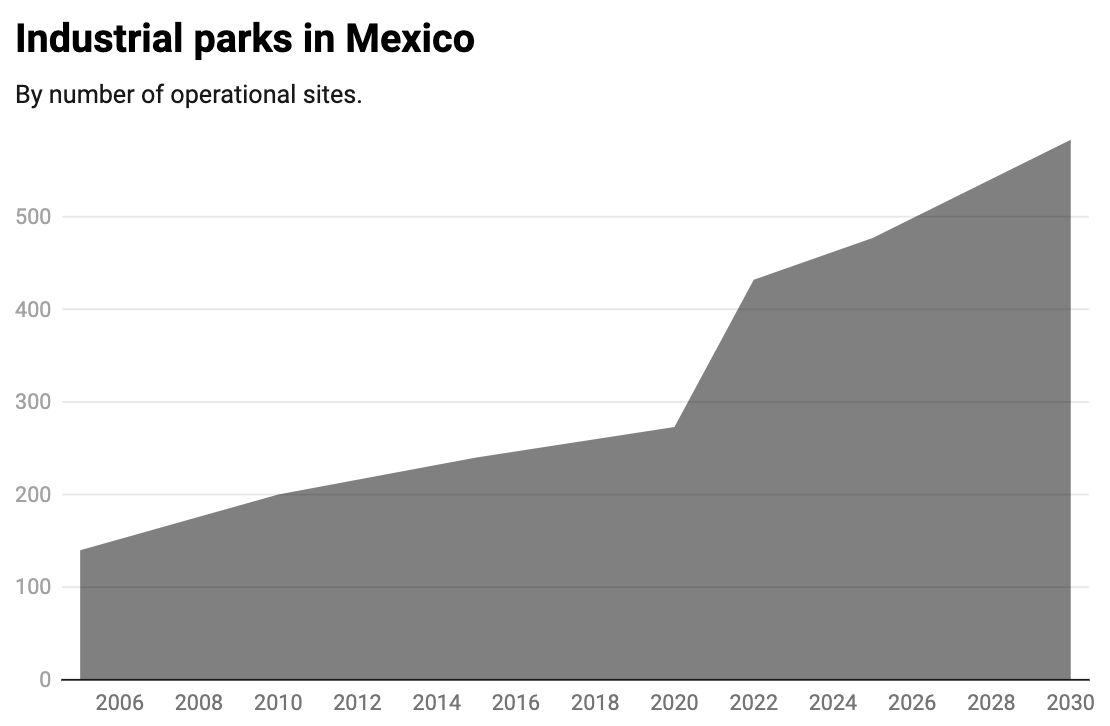
The government pledged 100 new industrial parks by the end of Sheinbaum’s term in 2030. Yet, because the government doesn’t have the money to carry out these investments, what this promise has amounted to is chiefly to facilitate the private sector to build.
For starters, pension fund rules were loosened to incentivise investment into “riskier” domestic projects, chiefly these sorts of industrial sites. But, perhaps more importantly, the government promised to go from antagonist to facilitator in its relationship to industrial real estate developers.
Industrial parks are, in large part, bureaucracy-saving endeavours. Out of the three years it can take to build one, two have historically been taken up by wading through red-tape. This isn’t necessarily all bad: The environmental review process surrounding the expansion of the Pacific port of Manzanillo just last week led to the project being blocked given the threat it posed to a unique neighbouring lake ecosystem.
However, as the government’s focus has shifted towards prioritising economic growth, private industry is being asked to jump through fewer hoops. The Mexican energy industry saw what this looked like when it came to gas pipeline building in the previous Morena administration. Now, under Sheinbaum, the government is making the expansion of industrial real estate a less challenging endeavour, Claudia Esteves told The Mexico Political Economist.
Esteves, as the president of the Mexican Association of Private Industrial Parks (AMPIP), is now working closely with the government to lay the foundations for the rest of its Plan Mexico aspirations. “We are part of a strategic task force working alongside the government to unblock issues,” she said.
Through it, AMPIP was able to hand over 18 of the 100 promised industrial parks within 300 days of Sheinbaum’s administration. That may seem slow at first, but building the energy, water, roads, and waste infrastructure takes its time even with regulatory backing.
Source: AMPIP
By the end of 2025, more than half of these 100 parks were still in early development stages. But, by 2028, the hope is that most will be coming online.
The State: Penniless and powerful
This staggered expansion of the industrial real estate sector is normal, following the natural economic boom and bust cycle, but each one of these cycles tells its own unique story:
The post-pandemic boom was a product of the nearshoring craze which assumed that, as companies relocated closer to the US from distant Chinese factories, Mexico would come out ahead. This manufacturing explosion did somewhat materialise but nowhere near to the degree that was expected.
The latest expansion is different. It reflects less of a “build it and they will come” attitude and more of a hands-on approach—one led by the State. “We have a plan,” said Sheinbaum at the event in which she announced her 100 industrial parks. “It’s not just about waiting for the market to do its job; it’s not just about the public sector making investments.”
The private sector is consequently cautiously moving to the government’s tune. Industrial parks are being built along the new Interoceanic Railway, connecting the Pacific and Atlantic Oceans, in spite of a historic lack of infrastructure or qualified labour in Mexico’s more impoverished south.
Industry insiders also say that the industrial real estate sector was always going to build the aforementioned 100 parks. “That target was always AMPIP’s; Plan Mexico is just the branding.” Yet, they’re happy to give the government credit because, with official support, they say they’ll be able to roll them out in almost half the time.
Sheinbaum has also allowed for industry to opt out of the public electricity sector altogether, despite her administration’s push for a more State-run energy system. Although 98–100% of industrial parks are connected to the grid, according to Esteves, more and more are now being granted permits to generate power “behind the meter.”
Given that electricity access is business’ main worry, this quiet shift away from her predecesor—who was loth to give out private generation licences—has garnered Sheinbaum much goodwill within the business sector.
Whether the expansion of industrial capacity with reliable services will be enough to entice more companies to grow in Mexico remains to be seen. However, in a country with scarce public funding to give all companies everything they need, the boom in industrial parks is a necessary first step for Mexico’s broader manufacturing base to even have a chance at success.